
Kinesiology in West Kelowna: Bridging Rehab and Fitness
Living in the Okanagan means having access to an incredibly active lifestyle. We constantly move our bodies while hiking Rose Valley trails, biking local mountains, and playing community sports. However, this active lifestyle also comes with the inherent risk of injury. Searching for kinesiology in West Kelowna to help you recover is a crucial step toward better movement.
Recovering from a physical setback often feels like a journey of two distinct halves. The first phase focuses on managing acute symptoms and healing tissue. The second phase requires rebuilding strength, restoring confidence, and returning to normal activities.
At Westside Physiotherapy & Acupuncture, our multidisciplinary approach supports you through every single stage of this continuum. A pivotal component of our comprehensive care model is kinesiology, a discipline entirely dedicated to the science of human movement.
Residents seeking kinesiology in West Kelowna must understand how this profession bridges the gap between clinical treatment and full-scale fitness. This knowledge is essential for a safe return to the activities you love. It also helps reduce the risk of future setbacks.
Why Choose Kinesiology in West Kelowna for Active Rehabilitation?
A kinesiologist is a human movement specialist. They apply biomechanics, anatomy, and physiology to improve health, function, and athletic performance. The British Columbia Association of Kinesiologists (BCAK) states that kinesiologists utilize evidence-based research. They use this research to develop highly tailored exercise programs. These programs address your specific physical needs, movement dysfunctions, and limitations.
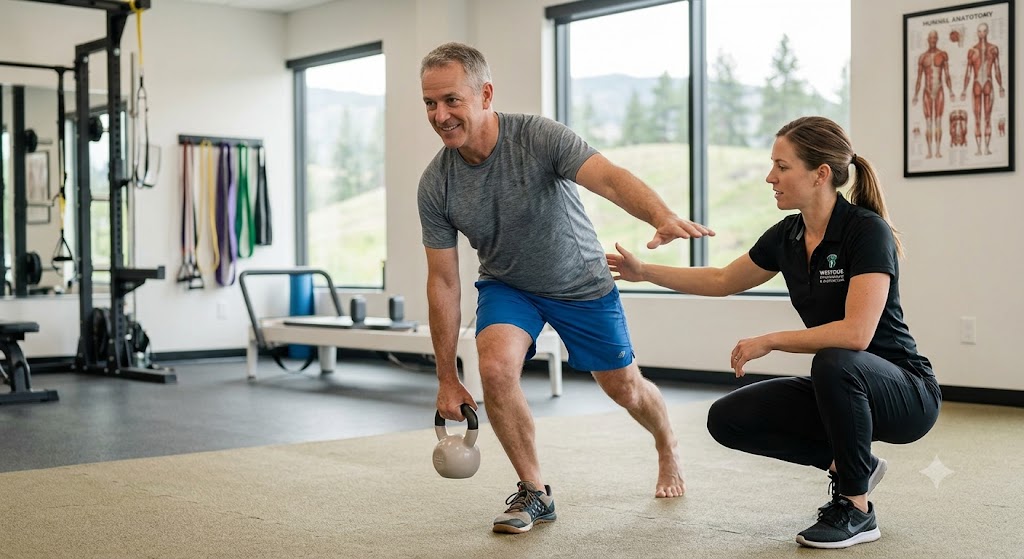
A kinesiologist works with you in a gym or dynamic studio setting rather than treating acute symptoms on a table. Their primary focus is on active rehabilitation. This means moving away from passive treatments and empowering the patient. You take an active role in your recovery by correcting movement patterns and addressing muscular imbalances. You will also safely load the body’s tissues to build long-term resilience.
The Anatomy of Recovery: Navigating a Ligament Sprain
Let’s look at a common, complex injury to illustrate the transition from acute rehab to full performance. A severe ligament sprain, like an ACL tear or a high ankle sprain, is a great example.
Following a ligament sprain, you will typically experience immediate inflammation, swelling, restricted mobility, and significant discomfort. Your physiotherapist is crucial during this initial, acute phase. They will conduct a thorough assessment and help manage swelling. They also restore your basic joint range of motion and use modalities or gentle manual therapy to calm irritated tissues.
However, a critical vulnerability remains once the initial discomfort subsides and the ligament begins its remodeling phase. The absence of intense discomfort does not mean the joint is fully ready. It may not handle the dynamic forces of running, jumping, or navigating uneven terrain. An injury often disrupts the neuromuscular connection between your brain and the affected joint. This is exactly where our experts in kinesiology in West Kelowna take the baton.
The Phases of Active Rehabilitation
A kinesiologist will design a progressive active rehabilitation program. This program guides you through several distinct phases of recovery. It helps you safely transition from basic healing to high performance:
- Neuromuscular Re-education and Proprioception: A ligament sprain often damages the mechanoreceptors (sensory receptors) within the joint. This impairs your proprioception, which is your body’s ability to sense its position in space. Kinesiologists use specific balance and stability exercises to retrain your brain to communicate effectively with the injured area. This is a foundational step in helping to reduce the likelihood of re-injury.
- Progressive Tissue Loading: You must appropriately stress tissues so they grow stronger. A kinesiologist gradually introduces weight, resistance, and time under tension to strengthen the muscles surrounding and supporting the healing ligament. By strategically loading these structures, the joint becomes more stabilized and capable of handling everyday forces.
- Functional Movement Integration: Life and sports do not happen in isolation. As you build foundational strength, your kinesiologist will transition you from simple, isolated exercises. You will progress to complex, multi-joint movements like squats, lunges, and step-ups. We tailor these movements to mimic the demands of your daily life, occupation, or specific sport.
- Sport-Specific Conditioning and Plyometrics: For those looking to return to recreational or competitive sports, the final phase involves advanced conditioning. Your kinesiologist will introduce agility drills, speed work, change-of-direction exercises, and plyometrics (jumping and landing mechanics). This phase is critical for preparing the body for the unpredictable, high-velocity demands of full athletic performance.
Physiotherapy vs. Kinesiology: The Continuum of Care
While there is crossover between physiotherapy and kinesiology, they generally focus on different stages of your recovery timeline. They are not competing disciplines; rather, they are highly complementary. Here is a breakdown of how they work together to support your rehabilitation:
| Feature | Physiotherapy (Acute/Early Rehab) | Kinesiology (Active Rehabilitation) |
| Primary Focus | Managing acute symptoms, supporting early tissue healing, and restoring basic mobility. | Building strength, improving endurance, and correcting movement mechanics. |
| Treatment Style | Often involves manual therapy, acupuncture, modalities (e.g., IMS, ultrasound), and gentle, early-stage exercises. | Exercise-based and dynamic, utilizing gym equipment, free weights, and functional movement drills. |
| Stage of Injury | Acute (immediately after injury) transitioning to sub-acute phases. | Sub-acute transitioning to recovered and performance optimization. |
| Primary Goal | Help the patient return to basic daily activities with greater comfort. | Help the patient return to high-level physical work, demanding sports, and peak fitness. |
The Psychological Benefits of Active Rehabilitation
An often overlooked aspect of severe injuries like a ligament sprain is the psychological impact. It is completely normal to experience fear, apprehension, or a lack of trust in your body after a traumatic injury. Passive treatments alone cannot rebuild this trust.
Active rehabilitation plays a massive role in overcoming kinesiophobia (the fear of movement). Working closely with a kinesiologist allows you to experience your body safely executing challenging movements. You conquer exercises you previously thought were impossible or dangerous. This guided, progressive exposure builds immense physical and mental confidence. Such confidence is vital for a successful return to your pre-injury lifestyle.
Quick Q&A: Understanding Kinesiology in West Kelowna
Not at all. While kinesiologists boost sports performance, active rehabilitation benefits almost everyone. It helps you overcome an injury, manage a chronic condition, or recover from a motor vehicle accident. It also improves functional movement for everyday tasks like gardening, carrying groceries, or lifting children.
This transition is a highly collaborative process. Your physiotherapist will typically recommend integrating kinesiology once you manage acute symptoms and restore basic range of motion. At this point, you are ready to focus on structured, progressive exercise to build long-term strength and capacity.
Some extended health benefit plans do provide coverage for kinesiology or active rehabilitation. We recommend checking with your specific insurance provider to confirm your coverage details. Additionally, ICBC funds active rehabilitation sessions for motor vehicle accident recovery. They include these kinesiologist sessions as part of your approved recovery plan.
Because kinesiology is an active, exercise-based therapy, you should wear comfortable athletic clothing and supportive closed-toe running shoes. Expect to be moving, lifting, and possibly sweating. Your session will look like a guided personal training session focused on clinical rehabilitation. It rarely resembles a traditional medical appointment.
Take the Next Step in Your Recovery Journey
Transitioning from the treatment table to the gym floor is an empowering and exciting phase of your rehabilitation. Integrating kinesiology in West Kelowna into your physical therapy care plan equips your body for success. This approach prepares you for the rigorous demands of your daily lifestyle.
You do not have to stop your recovery journey once your initial symptoms subside. Building a strong, capable body is an excellent way to support your long-term health and athletic aspirations. Are you ready to bridge the gap between rehab and fitness? Book a session with our active rehabilitation team today. You can also contact our West Kelowna clinic to see how we can support your journey back to peak performance.
